

Our Farm's Journey
Rooted in Land, Grown Through Community
The Phillies Bridge Farm Project was founded in 1994 and became a non-profit organization in 1999, after the visionary Working Group on Family Farms leased land to create a demonstration farm that would focus on ecologically sound farming techniques and community education.
This developed into the Phillies Bridge Farm Project, and in 2002, the farm's owners, James and Mary Ottaway, donated the farm to the nonprofit organization.
In 2022, board member Steve Goodman spearheaded a deep dive into the farm's forgotten history. You can read the full document, titled Making Visible the Erased History of our Farm and Community, here.
Our Commitment
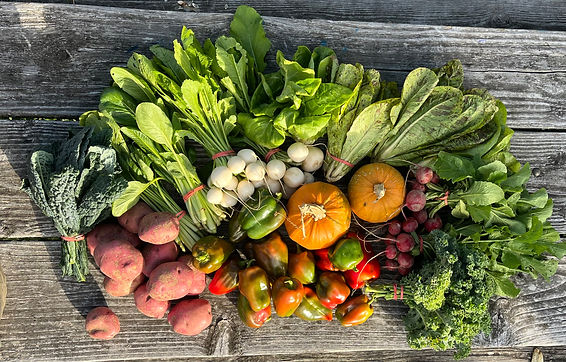
Located on 65 scenic acres in New Paltz, NY, Phillies Bridge Farm Project includes five acres of cultivated land used to grow vegetables, herbs, and flowers with sustainable farming practices, in addition to an Education Garden, an interactive Children's Discovery Garden, and 45 acres of woods and wetlands that feature a 1.5 mile self-guided nature trail that is open to the public.
At Phillies Bridge Farm, our mission is to create a sustainable community centered around food justice and education. We aim to empower individuals and families through access to fresh produce, while fostering a deeper understanding of agricultural practices and their importance.
We offer a summer and winter CSA, summer camp, field trips, adult education, nature walks, and more! Check out our agriculture and education pages to learn more about our offerings! We hope you see YOU at the farm!

Meet the Team

Interim Executive Director
Ella Schwarzbaum She/Her
Ella is a New York City native who came to agriculture as she learned more about the industrial farming system that provided most of the food around her. Ella majored in Environmental Studies at Binghamton University and received a masters in Childhood Education, General and Special Education (grades 1-6). After teaching elementary school science in the South Bronx it was time for a change of pace, and she has been farming in the Hudson Valley ever since. It's a treat to combining her love of education and farming as part of the Phillies Bridge Farm Project family!

Farm Director
Ellen Conti She/Her
Ellen grew up playing in the woods and learning about nature and science. Her favorite part of work is sharing her love of learning and farming with our apprentices while leading the farm. Before farming, Ellen went to the SUNY College of Environmental Science and Forestry, receiving degrees in Bio-Process Engineering, Mathematics, and Renewable Energy during her four years there. Her first career was as a Chemical Engineer with a focus in energy production. She went on to receive an MBA with a focus in Technology Management before eventually bringing her experience into her role as Farm Manager at an organic market farm.
Ellen and her dog Amelia look forward to making new connections with the community each season. Outside of work she enjoys walking in the woods, mountain biking, spending time with friends and family, reading and cooking.

Administration & Finance Manager
Jazmine Langlitz She/Her
Beginning her tenure with Phillies Bridge as the camp director, Jazmine moved into the administrative office in 2020. A Hudson Valley native, Jazmine obtained a degree at SUNY New Paltz in visual arts and fell in love with the town. She went on to receive her Masters Degree from Endicott College in Montessori Integrative Learning. She enjoys teaching math and is intrigued by the connections between math and nature. In her spare time, Jazmine explores mounted archery and trail riding with her horse, Pax, and hangs out with her family while camping, hiking, skiing, and fishing.

Assistant Farm Manager
Haidee Sticpewich She/They
Haidee is excited to be back in New York farming, after finishing her Master's degree focused on Agroecology at the University of Michigan. From being introduced to farming and food system work during high school, she quickly came to love the hard, daily labor of farm work and the wonderful communities that grow up around these spaces. She has been lucky to learn from the work of farmers in New York state and in Detroit while working in various roles such as assistant farm manager, field crew leader, irrigation specialist and a tractor operator. Her work has supported farms in their missions of food justice, access, and education. Haidee is looking forward to doing the same here at Phillies Bridge and can't wait for the 2026 season!

Farm Apprentice
Michele O'Kane
Hello! My name is Michele. I grew up on Long Island and got my BFA in film photography from Pace University in NYC. After spending years joking that I wanted to move away and work on a farm, I moved to New Paltz in 2025 to surround myself with more nature and community. Volunteering at PBFP led to becoming a part time farm hand, which led me to fall in love with farming immediately. I couldn’t help but want to return back as an apprentice to dive head first into the full time experience and learn everything that I possibly can. It excites me to help bring fresh, nutritious food to the people of my new community!

Farm Apprentice
Isabella Mackenzie
Hi my name is Izzy and I'm so excited to be a part of the Phillies Bridge farm crew this season. After training in the culinary arts for the past five years and studying applied food studies, I developed a deep appreciation for working with local, sustainable ingredients. My experiences in the restaurant industry led me to discover my passion for the agricultural side of the food system and fueled my enthusiasm to contribute to a just world where everyone has access to local, sustainable food. In my free time, I enjoy immersing myself in books about ecology, social movements, and environmentalism, which inspire my commitment to sustainable living.
Diversity, Equity, and Inclusion Statement
At the Phillies Bridge Farm Project, we are deeply committed to diversity, equity, and inclusion in all of our work—and to creating a safe, welcoming, and loving community on the farm. We strive for inclusive representation on our board and staff, equitable decision-making processes, and the delivery of programs that promote racial and economic justice. As an agricultural institution, we feel it is our responsibility to acknowledge and actively fight against the systemic exploitation and disenfranchisement of people of color when it comes to land access and farming. We do not discriminate—or tolerate discrimination or disrespectful behavior—on the basis of race, color, religion, gender, gender expression, age, national origin, disability, marital status, sexual orientation, or military status, in any of our activities or operations.
In 2020, Phillies Bridge initiated a formal process of self-reflection and situating our organizational and personal histories in the context of systemic inequality. That fall we hired a professional racial justice educator to lead the board in two Diversity and Inclusion training sessions. As a result of this work, we started the process of reimagining how our organization could actively build and maintain an inclusive environment and be a more effective ally to the community across all our differences. We began to hold regular racial equity meetings where we discuss the next steps and examine anti-racism on personal and organizational levels.
In an effort to hold ourselves accountable, we have committed to work toward the following goals:
-
Develop a means to evaluate our progress toward becoming a more inclusive institution;
-
Review and develop policies to promote a more inclusive and equitable environment;
-
Involve members with a breadth of experiences and identities on our board, staff, committees, education programs, and CSA;
-
Continue to partner with organizations that are experts in the needs of their local communities; and
-
Reexamine the history of the farm through an anti-racist lens.
-
In 2023, 30% of the produce grown at Phillies Bridge will be going to participants in our food justice programs, which serve low-income families and historically disadvantaged groups.
Feedback from our community members is crucial to our success. Phillies Bridge has a range of committees, all of which are deeply involved in realizing important organization-wide changes. Please reach out to us at info@philliesbridge.org if you are interested in joining a committee or have perspectives you would like to share with us.
This statement is a working document. We will make updates and revisions as we learn more about our history and make progress towards our goals.
Last revised February 27, 2023